
Introduction:
Organizations that rely on paper-heavy intake often spend too much time sorting documents, keying data, correcting errors, and tracking work manually. Applications, forms, checks, correspondence, evidence, and attachments may arrive through postal mail, email, fax, online portals, mobile submissions, or secure file transfers. When each channel is handled differently, staff lose time and leadership loses visibility into what has arrived, what is pending, and where bottlenecks are forming.
Intelligent mailroom automation gives organizations a more reliable way to receive, digitize, classify, validate, and route inbound information. Instead of treating intake as a manual front-desk activity, IIG turns intake into the first step of a secure, auditable digital process.
What Is Intelligent Mailroom Automation?
Intelligent mailroom automation is the use of document capture, optical character recognition, intelligent classification, data extraction, validation rules, and workflow routing to convert inbound communications into structured, actionable information. The goal is not only to scan documents, but to understand what each document is, extract the information needed by downstream systems, and send it to the right process without unnecessary re-entry.

With IIG, organizations can consolidate multiple intake channels into one controlled digital intake process. Physical mail can be scanned, emailed attachments can be captured, portal submissions can be received, and file transfers can be processed through a consistent framework. From that point forward, the organization can apply the same governance, security, indexing, and routing standards across all content.
What Is Intelligent Mailroom Automation?
Manual intake is often slow because each document must be opened, reviewed, sorted, scanned, named, indexed, and routed by staff. Even experienced teams can make mistakes when volumes increase or when forms are incomplete, inconsistent, or submitted through different channels.
These delays affect more than back-office productivity. In mission-critical programs, slow intake can delay application processing, case initiation, payment handling, investigations, customer response, and compliance review. When the first step of the process is fragmented, every downstream step inherits that delay and uncertainty.
How IIG Modernizes the Mailroom
IIG applies automation at the point of entry. Documents are captured from mail, email, portals, faxes, and file transfers. OCR converts scanned images and PDFs into searchable text. Classification identifies document types such as applications, invoices, checks, correspondence, case records, and supporting evidence. Data extraction captures key fields, and validation rules help confirm that required information is present and usable.
Once information is digitized and validated, IIG securely routes it to the correct downstream system, repository, queue, or workflow. This creates a stronger foundation for processing because staff receive work that is already organized, indexed, and connected to the right business context.
Benefits of Intelligent Mailroom Automation
The most immediate benefit is faster intake. Staff spend less time sorting and entering data and more time reviewing, resolving, and serving. Automated classification and extraction also improve data consistency by applying the same rules across similar documents.
Managers gain immediate visibility into inbound workload volumes, pending items, processing trends, and exceptions. This visibility helps teams address backlogs before they become larger operational issues. For regulated environments, secure handling and audit trails support stronger accountability from the first moment content enters the organization.
Built for Government and Regulated Programs
Government agencies and regulated organizations need more than speed. They also need security, transparency, and defensible records. IIG supports role-based access, policy-driven routing, auditability, and governed document handling so that sensitive and regulated content is protected throughout the intake lifecycle.
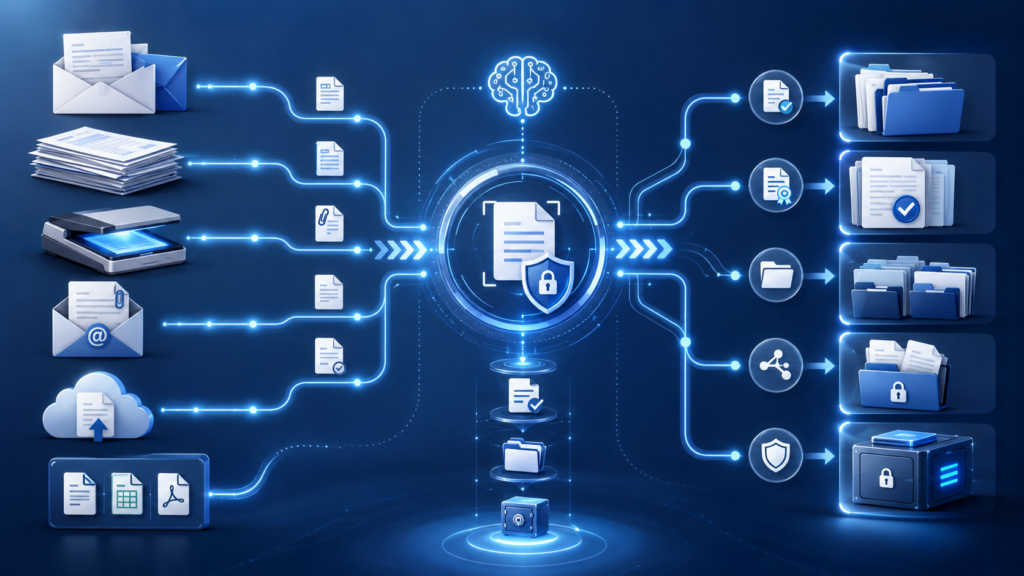
By connecting intelligent intake with workflow automation, records management, analytics, and enterprise search, IIG helps organizations move from paper-based intake to a digital operating model that is faster, more accurate, and easier to audit.
Conclusion
Intelligent mailroom automation is a practical starting point for broader digital transformation. When intake becomes structured, secure, and workflow-ready, organizations can reduce backlogs, improve data quality, strengthen compliance, and deliver better service. IIG helps agencies and enterprises transform inbound communications into trusted digital information that drives mission-critical work forward.
About IIG
Information Intelligence Group (IIG) delivers mission‑critical automation solutions that transform high‑volume, manual, paper‑based processes into secure, auditable, and scalable digital systems—supporting enterprise organizations across government and the private sector.